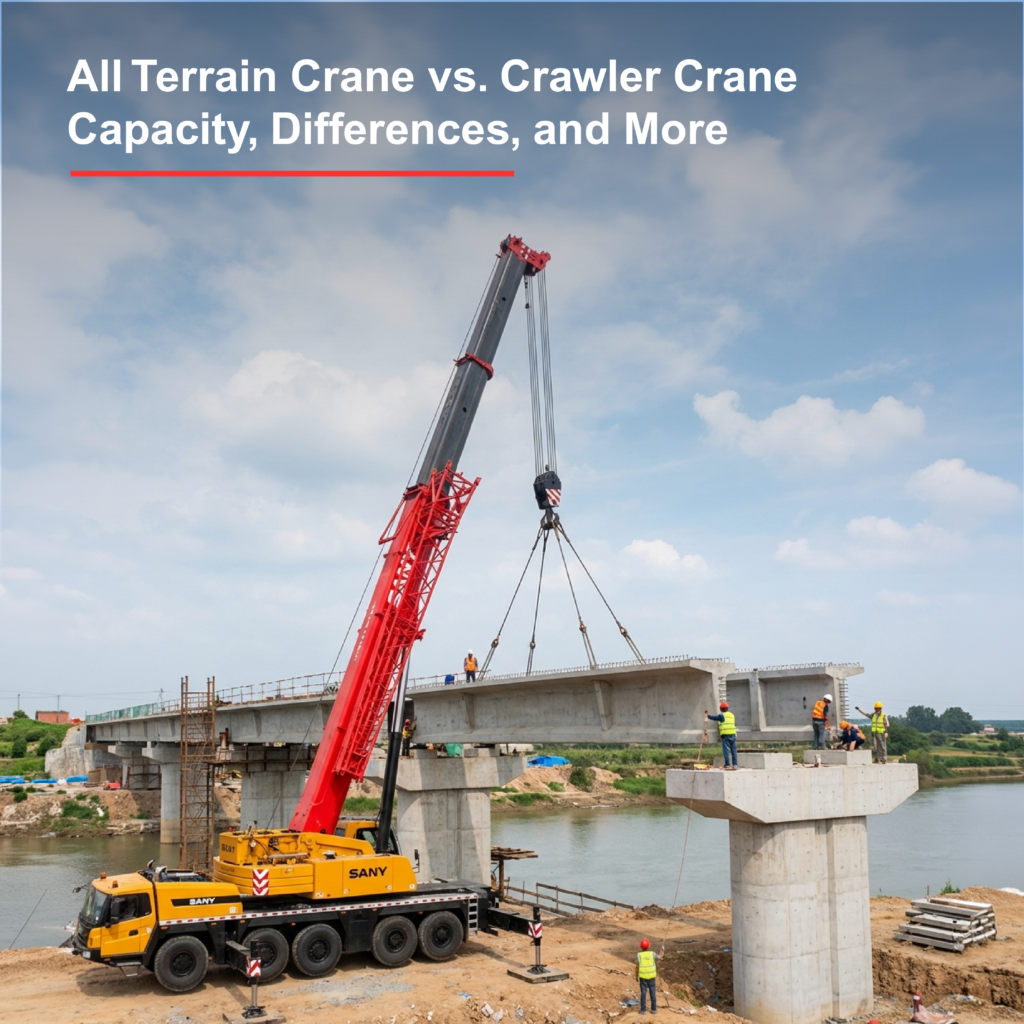
All Terrain Crane vs. Crawler Crane | Capacity, Differences, and More
Category: All-terrain Cranes, Cranes, Crawler Cranes | 18 March 2026
Whenever a construction project gets underway, choosing the right crane can make or break the efficiency and safety of your work. Picture this: you’re about to install a massive wind turbine. You’ll want a crane that combines efficiency with a long reach to handle large components with speed and precision. Now consider building an airport runway, dealing with heavy concrete slabs and steel. For such a project, you need massive lifting capability and unbeatable stability. So, which crane suits your project best—an all-terrain crane or a crawler crane? Let’s find out.
The Expanding Demand for Cranes in India’s Infrastructure Growth
India’s infrastructure is undergoing rapid transformation. With investments reaching USD 1.4 trillion by 2025, propelled by initiatives like the Smart Cities Mission and Bharatmala, the need for specialized cranes has surged spectacularly. Heavy industries such as power generation, steel manufacturing, and oil & gas facilities particularly rely on cranes capable of lifting massive loads with precision. This growth demands well-informed lift plans tailored for heavy crawler crane boom configurations and agile cranes that can shift quickly between sites
What Is a Crawler Crane, and When Is It Ideal?
Crawler cranes get their name from their tank-like tracks, offering unmatched stability on difficult, uneven, or soft ground conditions. This makes them the backbone for heavy-duty, extended construction projects such as bridge building, port installations, or large-scale industrial plants where mobility over tricky terrain and high lifting power are essential.
Take the Sany SCS1500A crawler crane, for example. It boasts a max lifting capacity of 150 tons with a boom length stretching up to 76 meters. This model’s lattice boom and flexible jib combinations allow it to handle diverse heavy crawler crane boom configurations. Its powerful engine, sophisticated SYIC-III control system, and advanced safety features like load moment indicators and predictive maintenance enhance both safety and operation efficiency.
Crawler cranes excel where site conditions challenge wheeled cranes—think marshy grounds, freshly excavated soil, or rugged terrains. They offer deliberate, precise lifting with stability that ensures safety even under the heaviest loads.
What Is an All-Terrain Crane, and When Should You Choose It?
All-terrain cranes are designed to move quickly between job sites while still being capable of handling rough terrain. They roll on multiple axles with tires and have advanced steering and suspension to handle highways and moderate off-road conditions. This makes them perfect for projects where quick setup and mobility across multiple locations are essential—for example, urban building projects, wind turbine installations, or airport maintenance. Globally, the all terrain crane market is booming, expected to grow from USD 18.32 billion in 2025 to USD 24.11 billion by 2030. India’s Sany SAC4500T7 is a flagship, offering a hefty 450-ton lifting capacity and an 80-meter telescoping U-shaped boom. Its smart chassis design features six axles, adjustable suspension, and advanced steering modes that maximize mobility and operator comfort. Crucially, its wireless remote operation, anti-tipping systems, and precise load moment monitoring make it a reliable choice for projects that demand swift mobility, like urban infrastructure, wind farms, or airport maintenance.
What Other Factors Should Influence Your Crane Choice?
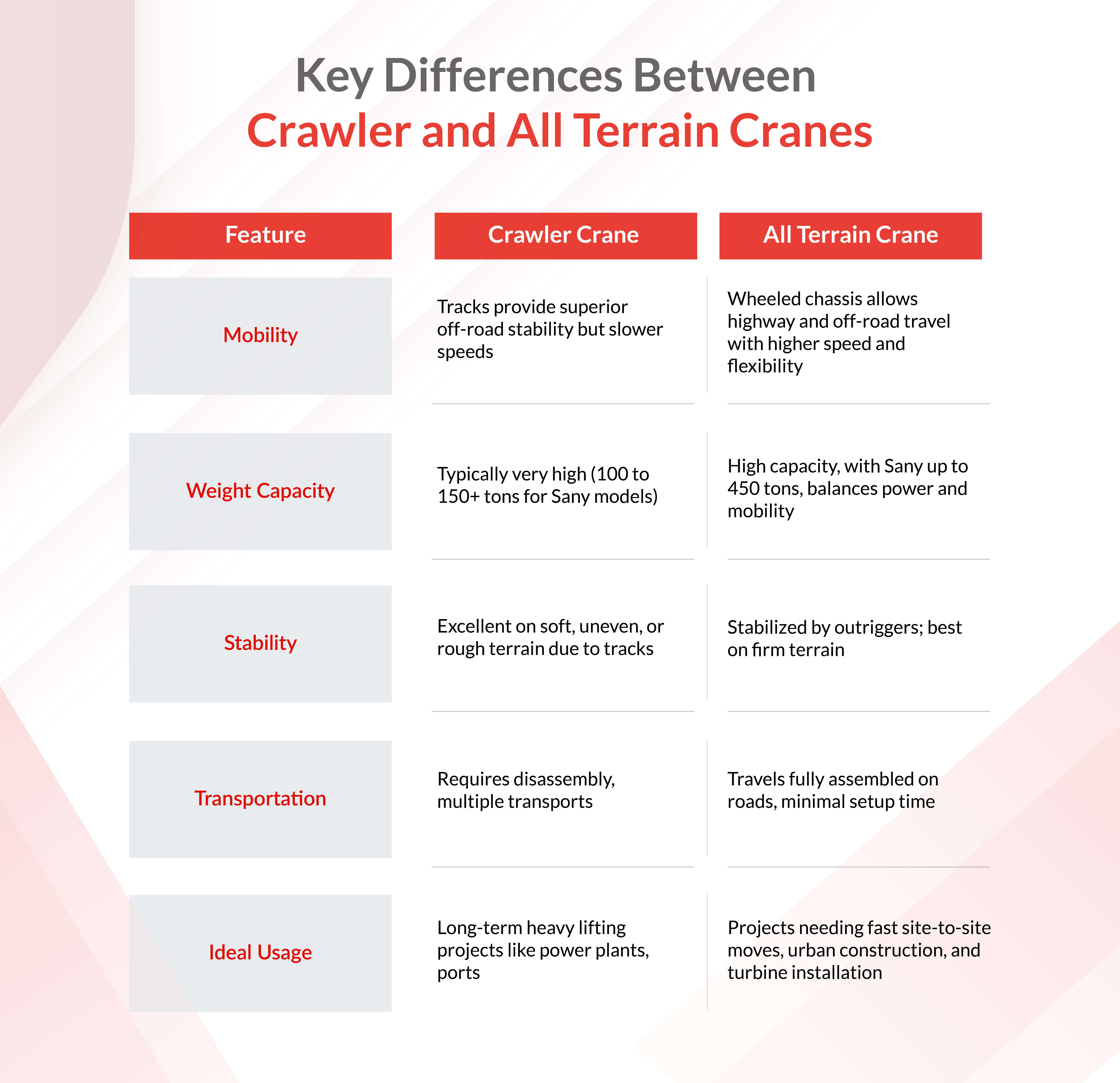
When choosing a crane for your construction project, focus on the essentials. Project duration matters: crawler cranes are best for long-term, heavy lifting jobs, while all-terrain cranes suit projects needing fast movement between sites. Terrain type is key—crawler cranes handle soft, uneven ground well, whereas all-terrain cranes work better on firm, paved roads. Transportation counts too; all-terrain cranes can drive to locations fully assembled, saving time and transport costs, unlike crawler cranes, which usually require disassembly. Lastly, align the crane’s boom length and lifting capacity with your lift plan to ensure safe, efficient operations. These factors help you pick the crane that fits.
Make the Right Crane Choice with Sany
Choosing a crane shapes your project success matching stability, capacity, mobility, and setup time to your needs is vital. Sany stands out with cranes tailored to India’s growing infrastructure demands. The SCS1500A crawler crane delivers power and reliability for heavyweight lifting across tough terrains, while the SAC4500T7 all-terrain crane offers unparalleled mobility and capacity for dynamic, fast-moving projects.
Related Blog
Crawler Crane Capacity for Heavy Lifting | 2026 Industrial Project Guide
In the rapidly evolving landscape of 2026 industrial projects, the demand for crawler cranes machines capable of extraordinary lifting power combined with unmatched terrain adaptability continues to climb steadily. These cranes are vital components in infrastructure, energy, and manufacturing sectors globally, facilitating the assembly of colossal structures and handling heavy loads safely and efficiently. According to a recent industry forecast, the global crawler crane market is projected to expand at a compound annual growth rate (CAGR) of about 5.7% from 2025 to 2033, underlining their growing importance in construction and industrial operations The Rising Market for Crawler Cranes The crawler crane market is witnessing robust growth driven by urbanization, infrastructure spending, and technological advancements. Valued at approximately USD 3 billion in 2024, the market is forecast to expand at a CAGR of around 5.2% through 2034, reaching new heights fueled by ongoing demand for heavy lifting equipment in mega projects and complex construction environments. Increasing investments in renewable energy, such as wind and solar power installations, alongside the need for upgrading aging infrastructure globally, continue to bolster crawler crane demand. Furthermore, Asia-Pacific, led by China and India, remains a powerhouse market for crawler cranes with rapid urbanization and industrialization. The focus on eco-friendly, fuel-efficient cranes equipped with smart technology features propels both new equipment sales and rental fleets, enhancing productivity and project safety. Crawler cranes distinguish themselves primarily through their tracked undercarriage, which spreads the machine's weight over a large surface area, vastly improving ground pressure distribution. This feature enables safe, steady movement on soft, uneven, and tricky terrain where wheeled vehicles falter. Their capability for 360-degree rotation paired with extendable multi-section lattice or telescopic booms makes them a versatile solution for heavy lifting needs in complex environments such as bridge building, offshore platforms, and high-capacity heavy manufacturing jobs. Key pain points addressed by crawler cranes include the following: Navigating challenging ground conditions while maintaining lift precision Handling heavy loads with high stability and safety Reducing downtime due to rapid assembly, disassembly, and mobility Exploring SANY’s Crawler Crane Innovations and Capabilities SANY’s crawler cranes reflect a synthesis of robust engineering, innovative control technologies, and operator-centric design, ensuring these machines meet the demands of challenging industrial projects. The standout models such as the SCS1000A and SCS1500A offer 100 and 150-ton lifting capacities respectively, with adaptable boom lengths reaching up to 76 meters with various jib combinations, offering wide operational ranges to…
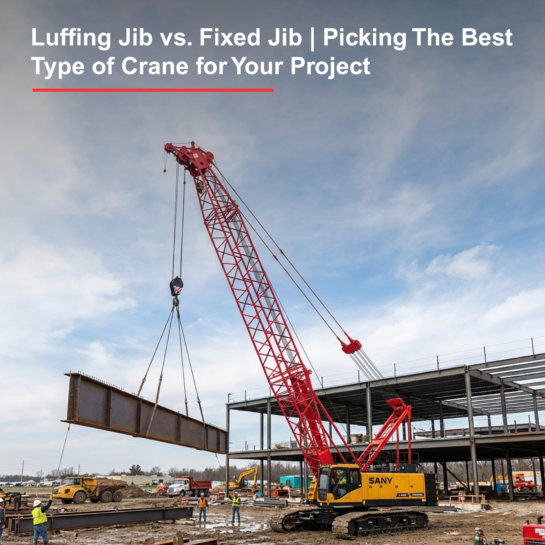
Luffing Jib vs. Fixed Jib | Picking The Best Type of Crane for Your Project
From the tall skyscrapers in Mumbai to the big warehouses in Pune, Gurugram, and Ahmedabad, cranes are a common sight, helping India grow. These giant machines are more than just metal and cables—they are behind the buildings, factories, and infrastructure that keep the country moving forward. The crane market in India is booming. It was worth about USD 1.48 billion in 2025 and is expected to grow to USD 2.06 billion by 2030, with steady expansion every year. But with many types of cranes available, how do you pick the right one for your project? This blog will explain the difference between two popular crane types—luffing jib cranes and fixed jib cranes—and help you decide which one fits your project best. We’ll also talk about how cranes like those from SANY come in flexible boom configurations to handle different lift plans. What is a luffing jib crane? A luffing jib crane has a special kind of boom called a jib that can move up and down. This up-and-down movement is called “luffing,” and it lets the crane change how far it reaches without turning the whole crane around. This kind of crane is great in crowded places like busy city construction sites where space is tight. The jib folds up when not in use, which means the crane doesn’t need a lot of space to swing around. For example, SANY’s SCS1500A crawler crane can have a luffing jib as long as 52 meters and a boom up to 76 meters. This makes it perfect for projects in places like Mumbai or Delhi where the construction sites are close to other buildings or cranes. What is a fixed jib crane? A fixed jib crane has a jib that stays fixed in one position—usually horizontal. It doesn’t move up and down like the luffing jib but stays straight. This makes it simpler to use and faster to set up. Fixed jib cranes work well in places where there is plenty of space, like large warehouses or factories. They are often used in industrial areas around Pune, Ahmedabad, Mumbai’s suburban zones, and manufacturing hubs near Gurugram and Noida. Which Crane Is Best for Your Project? Regional Fit in India Luffing jib cranes are suitable for crowded urban projects like Mumbai’s tall buildings or Delhi’s metro works. Their ability to adjust jib angles helps save space and reduce crane swinging, making it safer for…
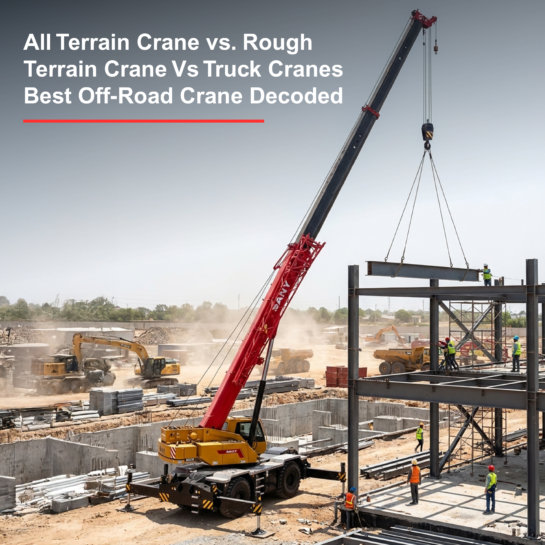
All Terrain Crane vs. Rough Terrain Crane Vs Truck Cranes | Best Off-Road Crane Decoded
Choosing the right crane for off-road construction sites is often fraught with challenges that go beyond simple lifting capacity. Many field professionals struggle with terrain-related mobility issues, lengthy setup and breakdown times, and the risk of costly downtime caused by equipment failures or unsafe operations. The consequences? Delays that push back project timelines, unexpected costs, frustrating operator difficulties, and sometimes severe safety incidents. Consider scenarios where improper crane selection, poor setup, or rough terrain suddenly compromised entire projects. In one instance, a crane collapsed due to unstable ground, emphasizing how crucial terrain adaptability is to preventing accidents and ensuring stability. In others, inefficient assembly procedures and lack of maneuverability slowed down work and extended operational hours. These challenges underscore why understanding the functional differences between all-terrain, rough-terrain, and truck cranes is vital not just for technical specs, but to truly match crane type to site conditions and operational needs. All Terrain Cranes: Purpose-Built for Complex Landscapes All terrain cranes blend the best qualities of truck cranes and rough terrain cranes, engineered for versatility and heavy lifting on diverse surfaces that range from paved highways to rugged, rocky off-road zones. Their design prioritizes stability and mobility, often featuring multiple steering modes and powerful engines to handle heavy loads without compromising speed or safety. Common pain points they address: The need to switch quickly between highway travel and tough off-road conditions Heavy lifting capacity combined with stability on uneven ground Minimizing setup and repositioning downtime on large-scale projects For example, SANY’s SAC600E all terrain crane offers up to 60 tons of lifting power, a 50-meter telescopic boom, and six steering modes including crab and coordinated steering—perfect for projects combining strength and agility. High cab safety and fuel efficiency also reduce operator fatigue and operational costs. Why It Stands Out Dual mobility: Can travel at highway speeds and handle tough, uneven terrain on site. High lifting capacity: Multi-axle design and telescoping boom ideal for heavy infrastructure projects. Advanced safety and operation: Load Moment Indicator system for real-time monitoring and safer lifts. Increased maneuverability: Multiple steering modes including crab and coordinated steering. Rough Terrain Cranes: Specialists for Soft and Uneven Grounds Rough terrain cranes are tailored for off-road jobsites with soft soil, uneven ground, and confined or complex environments like mining sites or remote construction zones. They provide excellent traction via four-wheel drive and combine strong lifting power with compact design for quick setup…
