Times Now Sustainability Awards
22 July 2024
Sany India is now recognized as a sustainable organisation due to efforts towards ESG, decarbonization & climate neutrality and was appreciated, honoured & awarded at the recently held Global Sustrainability Alliance 2024, at Mumbai.
Related Blog

Best Battery Forklifts for Indian Climate Conditions
India’s Diverse Climate and Impact on Forklift Performance India's vast and diverse geography results in multiple climate zones, each presenting unique challenges to industrial operations. Coastal areas like Tamil Nadu and Kerala experience high humidity and salt-laden air, which can accelerate corrosion of forklift battery terminals and connectors. Northern regions, including Punjab and Himachal, experience cold winters, during which sub-zero temperatures reduce battery efficiency and lifting capacity. Desert zones such as Rajasthan endure scorching temperatures often exceeding 45°C, which accelerate battery degradation, particularly in traditional lead-acid designs. Monsoon seasons add moisture complexities requiring waterproof battery housings and elevated charging stations. The As businesses across sectors adapt to these regional challenges, the demand for reliable, all-weather electric forklifts continues to rise. According to market projections, the electric forklift market in India is expected to reach a revenue of US$5,936.4 million by 2030, underscoring the growing shift toward battery-powered models designed to perform efficiently across India’s varied climate conditions. Climate Considerations for Battery Forklifts Battery forklifts deployed across India's regions face these environmental factors: Coastal areas contend with corrosion risks due to constant humidity. Northern cold reduces battery discharge rates and torque. Desert heat accelerates water loss in lead-acid batteries and causes thermal stress. Monsoon rain demands rugged waterproofing and well-drained charging areas. Such environmental stressors directly impact voltage stability, battery lifespan, and maintenance frequency, influencing forklift performance in extreme weather outcomes. Lead-Acid vs. Lithium-Ion Batteries: Which Suits Indian Conditions? Lead-acid batteries have traditionally powered forklifts due to their low initial costs and proven track records, but they present several operational challenges in India's climate. They require constant water replenishment to counter electrolyte evaporation in hot conditions and emit hazardous fumes during charging. These fumes necessitate large, ventilated charging rooms, increasing facility overheads. For multi-shift operations, spare batteries and battery storage areas further raise costs. Performance sharply decreases in cold weather, with up to 35% capacity loss and severe performance degradation. Lithium-ion (LFP) batteries address these head-on with sealed designs eliminating watering and fume issues, allowing charging in non-ventilated rooms. LFP batteries operate effectively up to 50°C, provide consistent voltage and lifting torque across charge levels, and support rapid charging cycles—typically 1 to 2 hours. This supports opportunity charging during break periods and reduces downtime. The reduced internal resistance produces half the heat compared to lead-acid counterparts, enhancing safety and performance. In fact, lithium-ion technology is approximately 55% more efficient than lead-acid,…
50 Ton Truck Crane Lifting Capacities & Working Radius
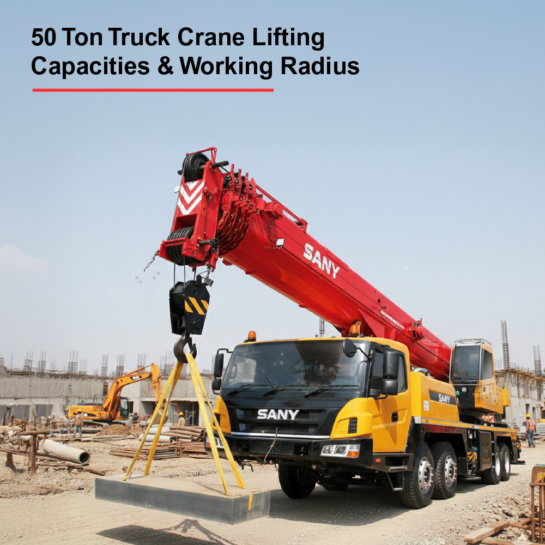
When your projects are spread across multiple sites and tight schedules leave no room for downtime, mobility and power become non-negotiable. That’s exactly where the 50-ton truck crane steps in — a machine that blends heavy lifting capability with road-ready agility. These cranes strike the perfect balance between capacity and convenience, traveling legally on highways while taking on substantial loads once on-site. Their ability to deliver powerful lifts without complex disassembly or transport setups makes them indispensable for urban, industrial, and infrastructure projects. It’s no surprise then that the mobile crane segment captured 63.12% of India’s crane market in 2024, driven by the need for quick deployment across roads, ports, and industrial sites. Contractors today depend on versatile cranes that can keep pace with compressed project timelines. Let’s explore why 50 ton truck cranes are a go-to solution for modern construction workflows — and how understanding their lifting capacities and working radius ensures both safety and efficiency. What Are 50 Ton Truck Cranes? 50 ton truck cranes are mobile cranes mounted on road-legal truck chassis, equipped with hydraulic telescoping booms that extend up to 43 meters or more, often including jib extensions for added height and reach. These cranes are designed for quick setup, stable loads, and precision lifting. Incorporated within their design are hydraulic outriggers for stabilization, load moment indicators for safety, and advanced electronics to ensure smooth operations. Their versatility spans sectors such as urban construction, infrastructure, and heavy industrial applications, delivering powerful lifts without sacrificing the ability to move rapidly between sites. Why 50 Ton Truck Cranes Are a Contractor’s Ally High mobility: These cranes move efficiently on public roads, avoiding complex transport logistics. Rapid deployment: Hydraulic outriggers and user-friendly controls reduce setup time, letting work commence swiftly. Versatile lifting: Capable of handling steel beams, machinery, precast concrete, and other heavy materials. Cost savings: One truck crane often substitutes multiple machines, cutting overall project costs. Enhanced safety: Real-time monitoring and precise control systems help prevent overload and maintain stability. Beyond mobility and performance, the market momentum behind these machines is strong. Worldwide sales of truck cranes are estimated at US$ 9.1 billion in 2023 and are forecasted to reach US$14.9 billion by 2033, expanding at a steady 5% CAGR. This growth reflects the essential role these cranes play in modern construction and infrastructure expansion. Sany STC500C Truck Crane: Precision and Performance in 50 Tons The Sany STC500C…
Electric Forklift Charging Station Setup Guide
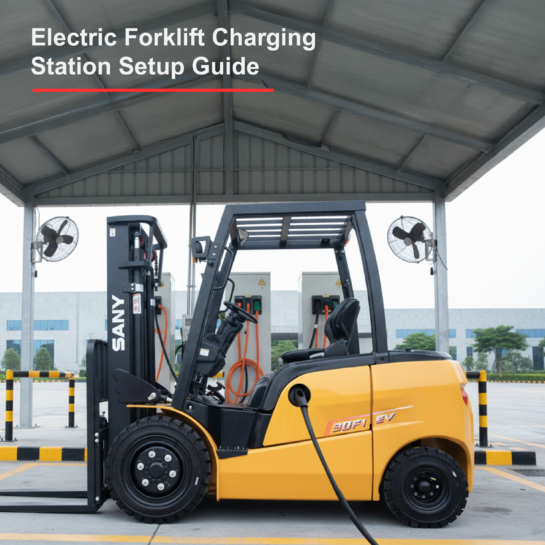
When a warehouse transitions to electric forklifts, the charging infrastructure deserves as much attention as the equipment itself. Perhaps more. Even the most advanced forklifts become a liability with poorly planned charging. Bottlenecks emerge at shift changes. Equipment sits idle during peak operational hours. Operators lose time searching for available charging stations. And without proper safety considerations built into the initial design, new hazards enter the facility. A well-executed charging infrastructure, however, keeps the fleet operational without disrupting workflow. Downtime becomes manageable and predictable. The work environment becomes demonstrably safer. What follows is a practical framework for building charging infrastructure that supports warehouse operations rather than hindering them. Step 1: Finding the Right Location for Charging Equipment The placement of charging equipment has a direct impact on operational efficiency and safety. Locations that are easy to reach from main work areas reduce the time forklifts spend travelling to and from charging. At the same time, charging stations should be positioned away from busy traffic zones where they could create bottlenecks during shift changes or peak hours. The physical environment matters too. Moisture, temperature swings, and accidental impacts can all shorten equipment life and create hazards. When working with lead-acid batteries, ventilation becomes particularly important since these units release hydrogen gas during charging. Adequate space is essential—10-12 feet of clearance around each station allows operators to manoeuvre safely. The flooring must handle the combined weight of fully loaded forklifts plus the charging equipment without stress. Step 2: Getting the Electrical System Ready Before installing anything, a licensed electrician should assess whether the current electrical infrastructure can handle the additional load. This assessment covers total amperage needs based on fleet size, voltage specifications (most industrial chargers use 208V, 240V, or 480V), and whether panel upgrades or dedicated circuits are needed to support the equipment safely. A single fast charger can pull 50-100 amps. Multiplied across a fleet, with room for future growth, this can mean substantial electrical work. Local safety code standards dictate many of these requirements, making compliance a fundamental part of the planning process from the start. Step 3: Selecting and Installing the Right Charging Equipment Chargers should match operational requirements. Conventional chargers work on an 8-hour cycle, making them cost-effective for single-shift operations with overnight downtime. Fast chargers cut that to 2-3 hours, which is essential for multi-shift warehouses where equipment downtime directly impacts productivity. Opportunity chargers allow battery…
