Lithium-Ion vs. Lead-Acid Battery for Forklift | 2026 Forklift Comparison
Category: Forklift, Material Handling | 18 March 2026
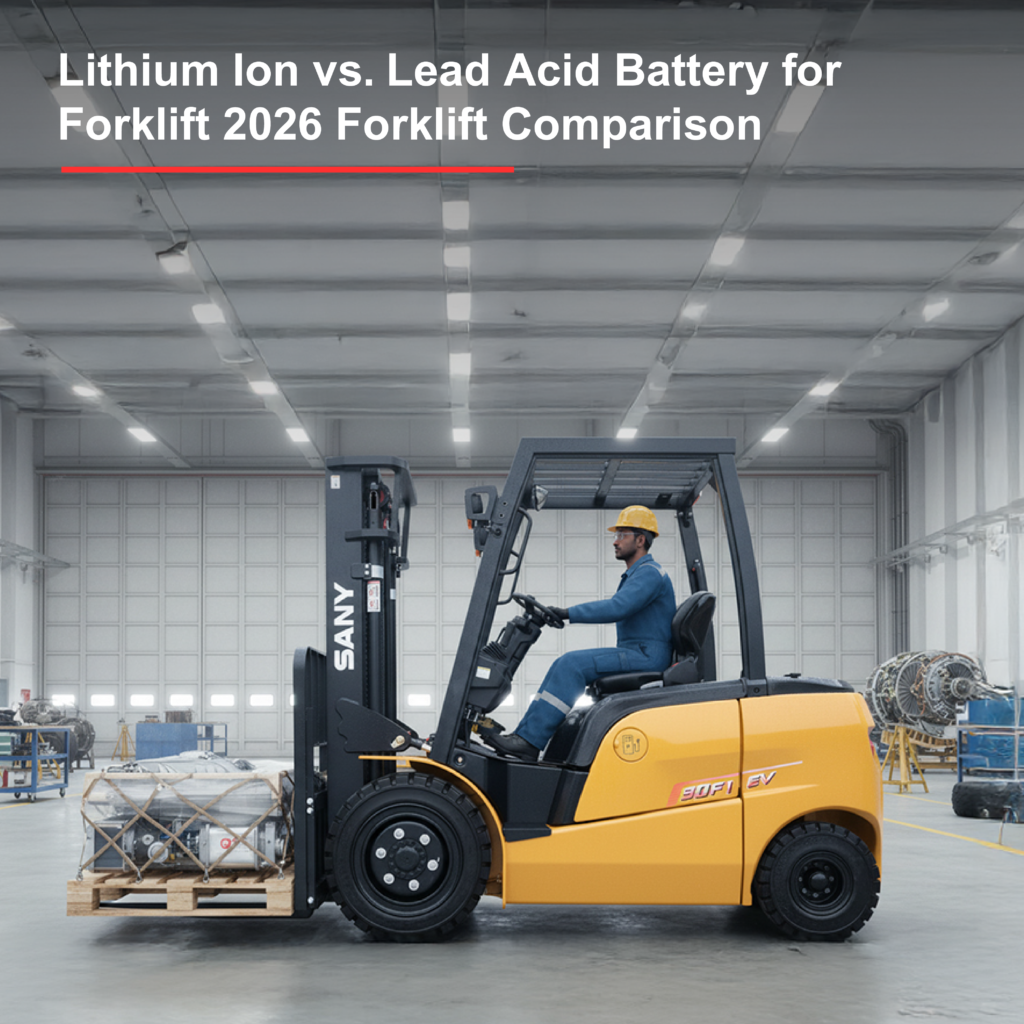
Who would have thought that the low-cost, dependable lead-acid battery, powering forklifts for decades in Indian warehouses and factories, would face such tough competition from lithium-ion technology as we enter 2026? Lead-acid battery forklifts have long been the industry standard thanks to their affordability and reliable performance.
However, with advances in forklift battery technology, lithium-ion battery forklifts are rapidly transforming material handling across India, offering faster charging, higher energy efficiency, and significantly reduced maintenance. This comprehensive comparison takes a deep dive into key differences, real statistics, and climate considerations shaping the future of forklift batteries.
Understanding Battery Forklift Technologies: Lead-Acid vs. Lithium-Ion
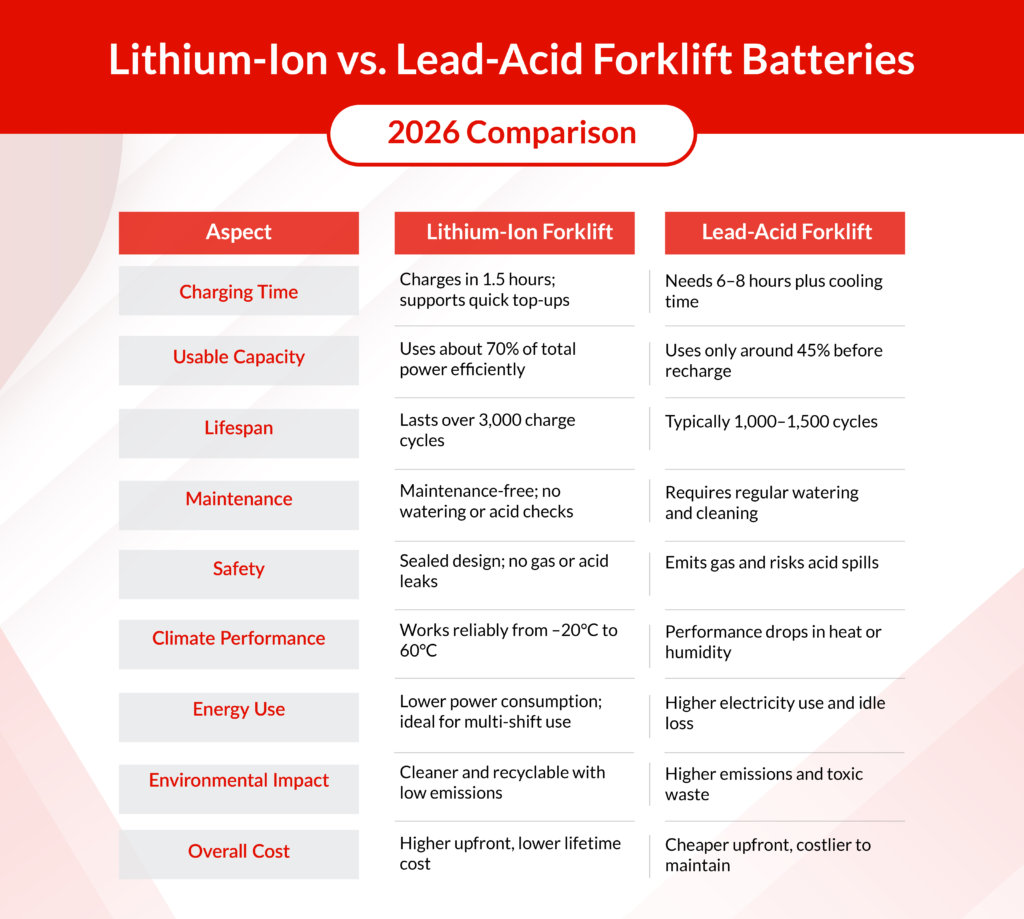
Lead-acid forklift batteries generate power through a chemical reaction between lead plates and sulfuric acid. While dependable, they’re heavy and require regular maintenance such as watering and cleaning. Their long charging cycles—typically six to eight hours plus a cooling period—limit flexibility and increase downtime in multi-shift warehouse operations.
Lithium-ion batteries mark a major leap in efficiency and performance. They can utilize about 70% of their total capacity, while lead-acid batteries use only around 45%, making lithium-ion models roughly 55% more efficient. They also generate only half as much heat, ensuring safer, cooler, and more stable performance even during intensive operations.
Modern lithium-ion batteries used in forklifts employ lithium iron phosphate (LFP) technology, which enables rapid charging—typically in about 1.5 hours—and supports opportunity charging, allowing operators to top up the battery during short breaks without affecting its lifespan. This flexibility minimizes downtime and extends forklift operating hours, improving productivity on the warehouse floor.
Beyond performance, lithium-ion batteries offer long-term cost and maintenance advantages. Lead-acid batteries require constant upkeep—watering, terminal cleaning, and electrolyte checks—while lithium-ion options are virtually maintenance-free and deliver over 3,000 charge cycles, compared to the 1,000–1,500 typical of lead-acid models. Their faster charging also reduces operational costs, with electricity consumption 50–70% lower per hour than forklifts powered by propane, diesel, or gasoline. With advanced thermal management, lithium-ion batteries perform consistently in India’s varied weather—from extreme heat to coastal humidity—while remaining efficient across temperatures from –20°C to 60°C.
SANY SCP50 and SCP30: Lithium-Ion Forklifts Made for India
SANY’s lithium-ion forklifts lead the way with cutting-edge battery forklift technology designed for Indian warehouses. The SANY SCP50 is a 5,000 kg capacity forklift powered by an IP67-protected 336V 50kWh lithium battery that charges fully in just 1.5 hours. This model handles dusty warehouses and monsoon moisture with ease.
Complementing the SANY SCP50 is the SCP30, offering a compact, maneuverable option for tighter spaces but powered by the same efficient lithium battery technology, ensuring high productivity and uptime. Larger battery options like 52 kWh and 70.7 kWh allow extended multi-shift operations and flexibility.
Safety and Environmental Benefits
Lead-acid batteries emit hydrogen gas during charging and pose spill risks due to corrosive acids, requiring ventilated charging rooms and strict handling procedures. Lithium-ion batteries are sealed and produce no harmful gases or acid spills, enhancing safety and enabling greener warehouse operations aligned with India’s sustainability goals.
Total Cost of Ownership: Why Lithium Pays Off
While lithium-ion batteries cost more upfront, the total cost of ownership is often lower over 3 to 5 years due to savings on maintenance, replacements, and energy. Indian logistics companies switching to lithium-ion report ROI within 19 months thanks to reduced downtime and energy consumption.
The Smart Choice for Indian Warehouses in 2025
While lead-acid batteries suit single-shift or low-budget operations, lithium-ion battery forklifts clearly excel in faster charging, longer lifespan, higher efficiency, and climate adaptability. Models like SANY’s SCP50 and SCP30 prove that lithium-ion battery technology delivers reliable, cost-effective, and environmentally friendly power tailored for India’s warehouse equipment needs.
If you’re planning to upgrade your fleet or explore long-term cost-efficient forklift solutions, contact SANY today to discover how our lithium-ion forklifts can power your operations with greater reliability, performance, and efficiency.
Related Blog
Future Electric Forklift Technology Trends for 2026 and Beyond
Electric forklifts hold over 70% of the market in many regions, with projections putting the segment above $100 billion by 2034. The shift isn't driven by regulation alone—the operational case has become harder to ignore. These aren't incremental improvements. They're changing the cost structure and uptime expectations for material handling operations. Here's a closer look at five technologies reshaping electric forklifts and what the data shows about their impact on productivity, safety, and operating costs. Battery Technology Advancements: The Power Behind the Revolution Battery technology has made real progress. Lithium-ion batteries achieved energy densities of 150-200 Wh/kg in 2024, up from 90-100 Wh/kg five years earlier. That's a significant jump that changes how forklifts operate. Today's lithium-ion batteries deliver energy efficiency up to 95% compared to lead-acid batteries' 80% efficiency. They charge in 1-2 hours, supporting 8-16 hour operational shifts. Opportunity charging lets forklifts top up during short breaks without affecting battery performance or lifespan. Lithium-ion isn't the only option anymore. Last year, manufacturers launched a pilot for electric forklift trucks equipped with sodium-ion batteries. These are designed for light-load operations and offer rapid charging, extended cycle life, and lower operational costs thanks to sodium's stable and abundant supply. Sodium-ion technology is still developing, but it presents an interesting alternative that could change cost structures across the industry. While batteries get most of the attention, hydrogen fuel cells are gaining ground. About 50,000 hydrogen forklifts operate worldwide as of 2024, mostly in the U.S. The benefits are clear: these forklifts refuel in just 2-3 minutes and produce zero emissions when using green hydrogen. Plus, you can store hydrogen on site without needing complex charging infrastructure. For operations running multiple shifts with minimal downtime, hydrogen fuel cells make sense. The technology combines the environmental benefits of electric power with the operational flexibility that internal combustion engines traditionally provided. Autonomous and Semi-Autonomous Electric Forklift Technology Trends The autonomous forklift segment is projected to grow from $2.73 billion in 2025 to $5.07 billion by 2032—a 9.3% CAGR. That kind of expansion requires substantial technological advances. Today's AGVs and AMRs can operate at heights up to 17 meters (56 feet) in very narrow aisles of just 1.8 meters (6 feet). Forklifts of the future will likely use 3D SLAM navigation combined with 3D laser adaptive sensing, providing fast project implementation and high cross-fetch repeat precision. The latest generation uses swarm intelligence, advanced systems where…
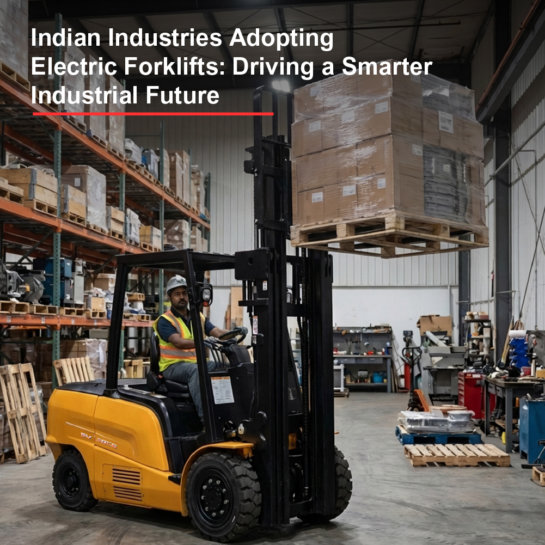
Indian Industries Adopting Electric Forklifts: Driving a Smarter Industrial Future
Scroll through the aisles of an IKEA warehouse, and every shelf, pallet, and packed carton reflects a quiet transformation: the rise of electric forklifts in India’s logistics and manufacturing ecosystem. As global retailers expand their footprint in India, the demand for faster, cleaner, and safer warehouse operations is reshaping how goods are handled, stored, and moved across the supply chain. From large manufacturing plants to modern retail distribution centres, industries are realizing that efficiency now means electric. These machines are cutting downtime, reducing costs, and improving safety all while supporting India’s broader push toward sustainable industrialization. This blog explores how electric forklifts are becoming indispensable across sectors. Why Electric Forklifts Are Becoming Essential The growing popularity of electric forklifts is a logical step for industries balancing productivity with environmental responsibility. Here’s why businesses across India are making the switch: Zero emissions: Electric forklifts eliminate harmful exhaust gases, ensuring clean air in enclosed environments such as food and pharmaceutical facilities. Lower noise levels: Quieter operation leads to safer workplaces and better communication on factory floors. Reduced maintenance costs: Fewer moving parts and no engine oil or filters mean less servicing and downtime. Automation compatibility: Their precision and IoT connectivity make them ideal for automated and smart factories. Today, many Indian forklift manufacturers are including features like autonomous navigation, telematics, and IoT-based performance tracking evidence that the electric forklift is evolving into a key part of digitally connected operations. Key Drivers of Electric Forklift Growth in India Sustainability and Environmental Goals India’s manufacturing and logistics sectors are under growing pressure to reduce emissions and adopt cleaner technologies. Government initiatives such as Make in India, Digital India, and the National Logistics Policy are driving industries to replace diesel forklifts with electric alternatives. The result is a cleaner, safer, and more efficient material-handling ecosystem that aligns with global sustainability goals. Economic Efficiency Electric forklifts offer tangible cost benefits. Their energy efficiency reduces power consumption, electricity is cheaper than diesel, and their simpler mechanics lower maintenance costs. Over time, this translates to higher uptime and lower total cost of ownership — critical advantages for industries operating on tight margins. The E-commerce and Logistics Boom The rise of online retail and digital logistics has intensified the need for quick, precise, and round-the-clock warehouse operations. Electric forklifts are the perfect fit — they charge fast, operate quietly, and move seamlessly through narrow aisles, making them ideal for…
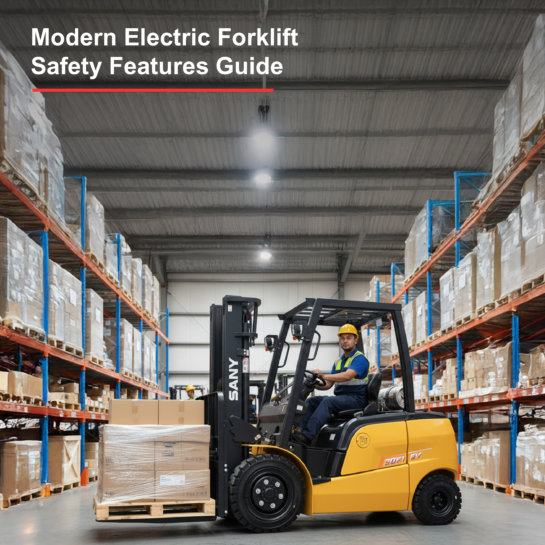
Modern Electric Forklift Safety Features Guide
Have you ever been inside a warehouse or factory where forklifts are constantly moving, picking, and stacking? These machines are essential to daily operations, speeding up material handling like nothing else. Recent years have seen a clear trend in Indian warehouses and factories: a growing share of electric forklifts are powered by lithium-ion batteries rather than traditional lead-acid ones, thanks to their efficiency and performance advantages. In fact, the Indian electric forklift market generated USD 1.95 billion in revenue in 2023, with lithium-ion forklifts representing the largest segment, and is expected to grow more by 2030 as more businesses upgrade their fleets. Why this shift? Lithium-ion batteries charge faster, last longer, and require less maintenance, making them increasingly desirable for modern warehouses. This shift is exciting—but it also comes with increased responsibility. Ensuring the safety of electric forklifts is critical to protecting workers and preventing accidents. In fact, OSHA reports that nearly 70% of forklift accidents can be prevented through proper safety measures. This blog walks you through everything you need to know about safety innovations in modern electric forklifts. Why Lithium Forklift Safety Matters The rapid adoption of lithium-ion-powered forklifts in India and worldwide can be attributed to their ability to boost warehouse productivity, lower maintenance requirements, and reduce overall operating costs. With the global lithium-ion forklift market projected to reach USD 58.7 billion by 2030, and India's own forklift battery market steadily shifting toward lithium-ion technology, warehouses are keenly aware of the efficiency gains. But these advantages come with unique safety concerns: lithium-ion batteries contain high-voltage circuits and can pose thermal risks, such as overheating or thermal runaway, if mishandled. Improper charging or unnoticed battery damage may increase the risk of electrical hazards or malfunctions. Therefore, modern lithium-ion forklifts are designed with a focus on robust safety features and require thorough operator training to address these emerging challenges. Only with the right practices and technology can warehouses fully harness the benefits of lithium-ion while protecting people and property. Safe Operating Procedures for Electric Forklifts Maintaining safety requires discipline and adherence to key practices: Charging Safety: Lithium batteries emit hydrogen during charging, which can ignite. Always charge in well-ventilated areas, keeping the battery cover open to prevent gas buildup. Forklift operators must turn off all chargers before connecting or disconnecting, to avoid sparks that could ignite gases. Regular Inspections: Check vent caps, electrical cords, and connectors for damage before…
